











Join our VIP list
Sign up for security product updates, new arrivals + exclusive discounts. View our Privacy Policy















 Sign in/Register New Account
 What Are You Securing?

SECURITY CHECK LIST FOR
Security gaps are rarely obvious until it's too late.
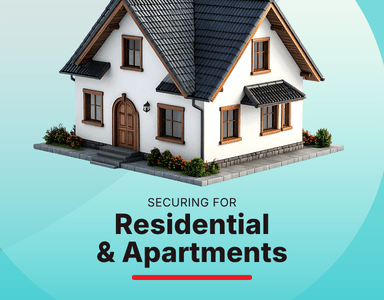
Most homes have some security. Few have the right security. This guide cuts through the noise, for example, what to install, where to put it, and what actually works for Australian homes and apartments. Read GuideMost break-ins don't happen because a home had no security. They happen because the security wasn't visible, wasn't working, or wasn't covering the right spots. A camera pointed at the wrong angle, a doorbell that doesn't record, or an alarm that was never armed. These are the gaps that cost homeowners and tenants their sense of safety.
For apartments, the challenge is bigger. Shared entry points, car parks, lifts, and common areas all need coverage. Strata rules, limited cable access, and rental restrictions shape what's possible. Without a coordinated system, residents are left vulnerable and building managers are exposed to liability.
Whether you own, rent, or install, this guide is for you.
| Item | What to Look For | Why It Matters |
|---|---|---|
| IP Cameras | 90° lens, colour night vision, IP65+ weatherproof | Clearer facial identification at typical apartment distances |
| NVR / Security Kit | 4 to 8 channel, local storage, 1TB+ | Continuous recording without cloud fees or subscription lock-in |
| Video Intercom | 2-wire or IP-based, app-enabled | Verify visitors before opening the door: from anywhere |
| Smart Lock | PIN, card, or app access | Keyless entry with access audit trail. Ideal for rentals. |
| Alarm System | Wireless PIR, door/window sensors, siren | Instant alerts for unauthorised entry. No cable runs required. |
| Sensor Lighting | Motion-activated, covers entry points and balconies | Strong deterrent. Works with or without cameras. |
Wide-angle lenses look impressive on paper but compress detail. Faces and number plates become harder to identify. A 90° lens at the right height (2.5 to 3m) gives clearer identification at the distances typical in apartments and home entry points. Don't sacrifice detail for coverage.
Standard infrared cameras produce black and white footage at night. Colour night vision cameras like Dahua TiOC and Hikvision ColorVu capture full-colour footage in low light, giving you better identification of clothing, vehicles, and faces when it matters most. Test your camera angles at night before assuming daytime positioning works after dark.
Wired systems record continuously, have no subscription fees, and keep recording even if your internet drops. For apartments where cable runs aren't practical or strata-approved, wireless cameras with local NVR storage are the next best option. Avoid systems that require cloud subscriptions to function.
Some systems only retain 3 to 5 days of footage. For 2 to 4 cameras recording continuously at 1080p, a 1TB drive stores approximately 7 to 14 days. Always check the recording schedule. Motion-only recording extends storage life but may miss slow-moving intruders. Spec up.
Tenants and landlords often can't do major cable runs. Wireless alarm systems like AJAX give full protection without drilling through walls, and they can be relocated when a tenant moves out.
For apartments especially, a video intercom at the main entry lets residents verify visitors from their unit before buzzing them in. IP-based intercoms with app integration mean residents can answer from anywhere.
Some Australian councils offer rebates for installing qualifying security systems. For example, the City of Wanneroo offers up to 30% back (max $500). Use an installer already aligned with council requirements so your system qualifies and the paperwork is straightforward. Keep all receipts and installation documentation.
Are all entry doors and windows locked, even when you are at home?
Are your garage, shed, and balcony access points secured when not in use?
Do you have cameras covering the front, back, and sides of your property — including entry points and car parks?
Are your cameras set to colour night vision mode and positioned at 2.5 to 3m height for clear facial identification?
Is footage stored locally with at least 7 to 14 days of retention (1TB+ for 2 to 4 cameras)?
Do you have a video intercom or smart lock at your main entry for visitor verification and access control?
Is a wireless or wired alarm system installed with door/window sensors and motion detection?
Do you have sensor lighting covering all entry points and dark areas around your property?
Choosing the right security system for a home or apartment can be overwhelming. Our team at Secure On Australia specialises in residential and multi-dwelling security. Whether you're specifying a single-camera install or a full building solution, we're here to help you get it right.

Q: How many cameras does a typical apartment or home need?
Most residential installs use 4 to 8 cameras: front door, back door, driveway, side gates, and secondary entry points. Apartments should also consider balconies and any shared access points where strata permits coverage.
Q: What's the best camera for an apartment front door or building entry?
A vandal-resistant dome camera with wide dynamic range (WDR) handles the lighting contrast between bright outdoor areas and darker lobbies. Pair it with a video intercom for full entry management. Mount at 2.5 to 3m for optimal face capture.
Q: Can I install security cameras in a rental apartment?
Yes, with limitations. Wireless cameras that don't require permanent fixtures are generally acceptable. Always check your lease and get written permission from your landlord for anything wall or ceiling mounted. Check strata by-laws for common area coverage.
Q: Do I need a subscription for my security camera to work?
Not necessarily. Systems with local NVR or SD card storage record continuously without any subscription. Cloud-based systems often require ongoing fees for full functionality. Check before you buy.
Q: Do I need council approval to install security cameras in Australia?
For most residential installs, no approval is needed. However, cameras must not capture neighbouring properties or public spaces beyond your boundary without consent. Check with your local council if unsure, and ask about any rebate programs while you're at it.
Q: What's the difference between a 4-channel and 8-channel NVR?
The channel count is how many cameras the NVR can record simultaneously. A 4-channel NVR suits small apartments or homes. An 8-channel suits larger properties with multiple entry points. Always spec one size up to allow for future expansion.
Q: Are security cameras effective at deterring break-ins?
Yes. Visible cameras are one of the most effective deterrents. Studies consistently show that properties with visible security systems are significantly less likely to be targeted. Combine cameras with sensor lights for maximum deterrence.
Sign up for security product updates, new arrivals + exclusive discounts. View our Privacy Policy
Thanks for subscribing!
This email has been registered!